


Stainless steel is a corrosion-resistant alloy widely used across demanding applications. Among them, 17-4 PH stainless steel and 304 are two of the most specified, making the 17-4 stainless steel VS 304. This article is about their composition, strength, corrosion resistance, cost, and common applications.
What is 17-4 Stainless Steel?
17-4 stainless steel is a martensitic alloy hardened by precipitation. It is a high-strength, highly corrosion-resistant material. It is typically employed in the aerospace, chemical, and food processing industries. The alloy is made of chromium, nickel, and copper, which offers improved mechanical properties.
What is 304 Stainless Steel?
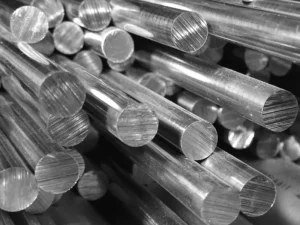
Stainless steel 304 is an austenitic alloy, which is highly corrosion-resistant and durable. It is made of iron, chromium, and nickel, and it is non-magnetic, oxidation-resistant, and rust-resistant. It is commonly used in kitchen equipment, chemical containers, and medical devices because it can be shaped and cleaned easily.
17-4 Stainless Steel VS 304: Top 10 Key Differences
Chemical Composition
- 17-4 Stainless Steel
17-4 stainless steel typically contains 15-17% chromium, 3-5% nickel, and 3-5% copper. It also contains small amounts of silicon, niobium, and manganese. Copper increases corrosion resistance, and niobium strengthens the alloy. This combination offers a fine balance of corrosion resistance, strength, and hardness.
- 304 Stainless Steel
The 304 stainless steel contains 18-20 percent chromium and 8-10 percent nickel. It is also composed of low levels of manganese, silicon, and carbon. This composition renders it highly resistant to oxidation and corrosion under various conditions. It is very versatile, with many applications, due to its high nickel content, which makes it highly formable and tough.
Heat Treatment and Hardening Capability
- 17-4 Stainless Steel
17-4 stainless steel is a precipitation-hardening (PH) stainless steel. It can be significantly strengthened through heat treatment. The typical H900 heat-treating process involves heating the alloy to 900°F, holding it at that temperature, and then air-cooling. This significantly improves the material’s mechanical properties, particularly its tensile and fatigue strengths. This makes the 17-4 one of the strongest stainless steels available.
- 304 Stainless Steel
The heat treatability of 304 stainless steel cannot be compared to that of 17-4 stainless steel. It is an austenitic alloy, meaning it cannot be hardened by heat treatment. Instead, it is strong due to its original composition and is normally used in the annealed form. The main reasons for heat treatment include relieving stress or increasing formability.
Mechanical Strength (Tensile, Yield, and Hardness)
- 17-4 Stainless Steel
The 17-4 stainless steel has high mechanical strength. Its tensile strength is 130,000 psi in the aged state, and the yield strength is 110,000 psi in the aged condition. It can be hardened to up to 45 HRC, making it suitable for high-strength applications in aerospace and industrial components.
- 304 Stainless Steel
The mechanical strength of 304 stainless steel is lower than that of 17-4. It has a tensile strength of 70,000 to 90,000 psi and a yield strength of approximately 30,000 psi. The degree of hardness is normally 20-30 HRC. It is less strong but has excellent corrosion resistance. Thus, it can be used in any application where strength is secondary to durability, such as food processing and medical equipment.
Ductility, Elongation, and Formability
- 17-4 Stainless Steel
The 17-4 stainless steel is not as ductile and elongating as 304 stainless steel. Its heat treatment is usually approximately 15- 20 per cent. The alloy is also hard and less formable, particularly after hardening. It does not have as good formability as it does strength. However, a complex shape or deep draw requires less strength than the formability of extruded sheet metal.
- 304 Stainless Steel
The stainless steel 304 has better ductility and elongation than 17-4. It is elongated in the 40-50 range, making it easy to form and shape. The alloy becomes very workable in both cold and hot conditions, making it suitable for complex shapes.
Toughness, Impact Resistance, Wear Resistance, and Hardness
- 17-4 Stainless Steel
17-4 stainless steel offers high hardness and excellent wear resistance. It also provides strong fatigue performance. This makes it applicable in demanding environments, such as aerospace and tooling. However, its toughness is lower than that of 304, especially at low temperatures. 17-4 stainless steel can become relatively brittle.
- 304 Stainless Steel
304 offers outstanding toughness and superior impact resistance, even at low temperatures. Its ductility and formability make it ideal for dynamic applications. 304 is not as hard or wear-resistant as 17-4. But it performs well where toughness and reliability against cracking are more critical.
Corrosion Resistance (General, Stress-Corrosion, Crevice, and Chloride Environments)
- 17-4 Stainless Steel
17-4 stainless steel has good corrosion resistance in a mild environment. But it is prone to stress-corrosion cracking in chloride-containing conditions. Its resistance to pitting and crevice corrosion is comparable to, or slightly better than, that of 304. But it should not be used in high-chloride or high-temperature environments.
- 304 Stainless Steel
Stainless steel 304 is characterized by excellent corrosion resistance, particularly in chloride environments. It is very opposed to overall corrosion, pitting, and crevices corrosion. Stainless steel 304 can withstand exposure to seawater and harsh chemicals better than 17-4 PH stainless steel. It is more appropriate due to its high nickel content, which makes it less prone to stress-corrosion cracking.
Magnetic Properties
- 17-4 Stainless Steel
17-4 is a stainless steel that is partly magnetic. It is a martensitic alloy and can therefore be hardened to develop magnetic properties. It is weakly magnetically annealed, but it becomes more magnetic with heat treatment. The magnetic response of the material also varies with the heat treatment procedure.
- 304 Stainless Steel
In its annealed form, 304 stainless steel is usually non-magnetic due to its austenitic structure. Slight magnetism may, however, be induced by cold working or welding. Nonetheless, it is mainly non-magnetic. It is therefore helpful in applications where magnetism may be objectionable.
Weldability and Fabrication Ease
- 17-4 Stainless Steel
The 17-4 stainless steel is harder to weld than the 304 stainless steel. It requires accurate control of the heat input during welding to avoid cracking. Heat processing can be required and is usually post-weld to reestablish mechanical properties. The substance is more difficult to forge, particularly when it is hardened.
- 304 Stainless Steel
304 stainless steel is very durable and easy to work with. It is austenitic in nature and therefore welds easily without preheating. It is also resistant to weld cracking, making it applicable to most welding methods. This is because of its ease of fabrication and welding, which make it preferable in most applications.
Cost, Availability and Ease of Sourcing
- 17-4 Stainless Steel
17-4 stainless steel is more costly than 304 stainless steel due to its alloy content and specialized treatment. It is not readily available, and sourcing it may not be easy. The alloy’s high strength and the heat treatment process also add to production costs. Consequently, 17-4 finds application in certain industries that need high-performance materials.
- 304 Stainless Steel
304 stainless steel is cheaper and more widely available. It is also among the most widely used stainless steels, which is why it is easy to find worldwide. It has broad involvement in industries such as food processing and construction, which makes it in stock with many suppliers. The convenience of availability keeps the cost lower than that of 17-4.
Applications
- 17-4 Stainless Steel
17-4 stainless steel is a high-strength, corrosion-resistant alloy widely used in demanding applications. The major industries are aerospace, defense, and chemical processing. Common components include valves, shafts, and structural parts that must withstand harsh environments.
- 304 Stainless Steel
304 stainless steel is a versatile, corrosion-resistant material commonly used across various industries. It is mostly used in food processing, medical equipment, and architectural applications. Typical uses include tanks, piping, storage vessels, and kitchen equipment. In these applications, corrosion resistance and ease of maintenance are crucial.
17-4 Stainless Steel VS 304: Which Should You Specify?
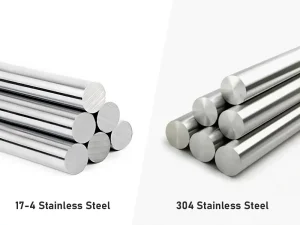
The choice between 17-4 and 304 stainless steel depends on the intended application. 17-4 is stronger and harder. It is suitable for high-performance, stress-resistant applications such as aerospace and defense. By contrast, 304 excels in corrosion resistance, formability, and machinability. This makes it suitable for food processing, medical, and architectural uses.
If strength and wear resistance are the primary considerations, 17-4 is the better option. If versatility and corrosion resistance are more important, 304 is the preferred option.
Conclusion
Each of them has distinct benefits based on your requirements. 17-4 is recommended for high-strength, high-performance applications. 304 is preferred for corrosion resistance and ease of manufacture.
Multi-Wins specializes in high-quality stainless steel CNC machining solutions tailored to your needs. Contact us today to learn how we can help with your next project.
FAQs
Does the “PH” in 17-4 PH mean it needs special treatment?
Yes. PH is abbreviated as precipitation hardening. This implies that it undergoes a special heat-treatment process. The procedure increases the material’s strength and hardness.
Are there circumstances where neither 17-4 PH nor 304 is ideal?
Yes. In very corrosive conditions with high exposure to acids or chlorides, both alloys may not have sufficient resistance. Such alloys are more specialized, such as stainless steel 316. It may be more appropriate in these situations due to its better corrosion resistance.
How does fatigue resistance compare between 17-4 PH and 304?
The 17-4 PH has much greater fatigue resistance due to its hardening, making it suitable for high-stress applications. Conversely, the fatigue resistance of 304 is lower, so it is not applicable in environments that require cyclic loading or stress.
Can 17-4 rust / corrode if not treated properly?
No. 17-4 is corrosible when heat-treated improperly or subjected to severe environmental factors such as high-chloride levels. It has good corrosion resistance, but it is necessary to ensure it receives appropriate post-processing treatment to maintain its properties.
What manufacturing or processing challenges come with 17-4 PH compared to 304?
After heat treatment, 17-4 PH is harder to machine and weld. It needs extreme accuracy in the welding process to prevent cracking. On the other hand, 304 can be welded and shaped more easily, making it more applicable to everyday production.